How to Write Song Lyrics: A Beginner's Guide
 Emma Calloway
You don't need to play an instrument or understand music theory to write song lyrics. You need a story to tell and the willingness to put it into words. That's it.
Maybe you're writing a song for your partner's anniversary, your mom's birthday, or a friend's wedding. You've got the feelings and the memories. You just need a way to turn them into lyrics.
Most guides on how to write lyrics for a song jump straight into music theory and rhyme schemes. We're starting somewhere more useful: what you actually want to say. Because the best lyrics come from real, specific moments between real people.
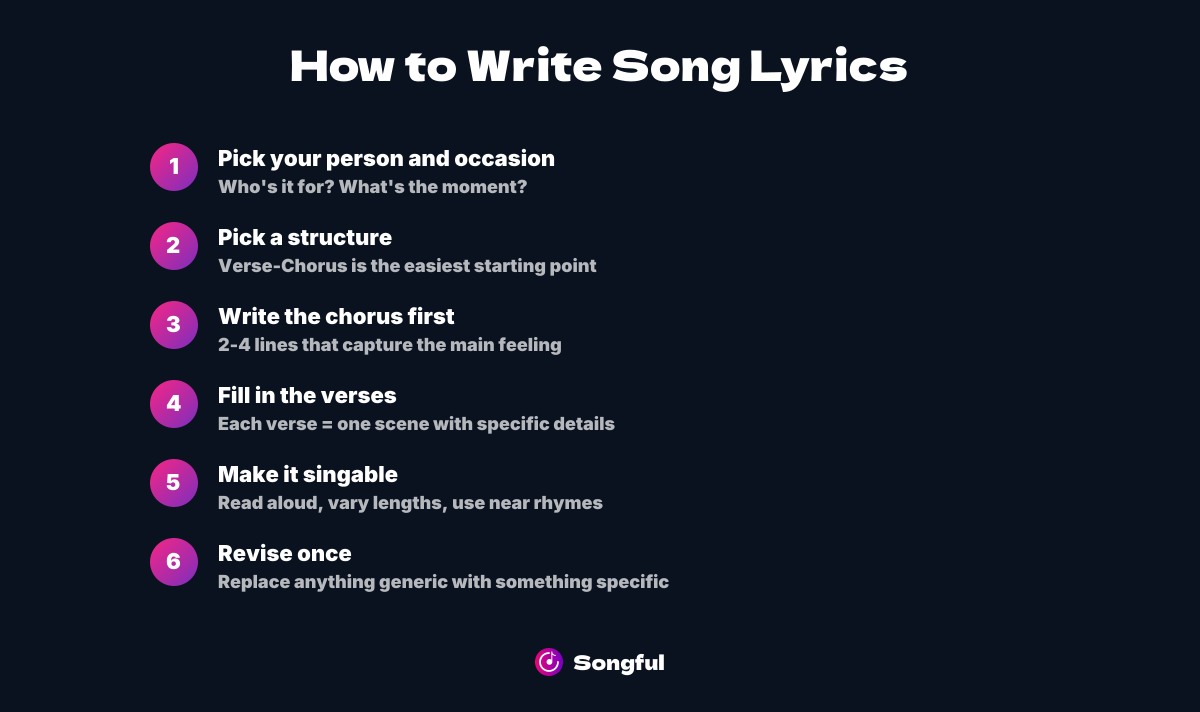
This guide walks you through the full process, from blank page to finished lyrics, with before-and-after examples at each step.
Start with the Story
Every good song starts with something real. A moment, a person, a feeling you can't quite shake. Before you write a single lyric, spend five minutes answering these questions:
Who is this song for? (Your partner, a parent, a friend, yourself)
What's the occasion? (Anniversary, birthday, wedding, retirement, or just because)
What's the one moment you keep replaying? (A conversation, a place, a look)
What do you want them to feel when they hear it? (Joy, gratitude, nostalgia, "you really know me")
What's a detail only you would know? (An inside joke, a habit, a phrase they always say)
That last question is the most important one. The details you think are too small or too personal? Those are usually the ones that make lyrics land. "You always hum while you cook" says more about a person than "You mean the world to me" ever could.
The occasion also shapes what you focus on:
| If you're writing for... | Lead with... |
|---|---|
| An anniversary | A shared moment that captures the whole relationship |
| A birthday | What makes this person specifically them |
| A wedding | The story of how you got here together |
| A retirement | Who they are beyond the job title |
| A parent | One memory that says everything |
Write your answers down. Don't worry about making them poetic. You're just collecting raw material.
Choose Your Song Structure
Song structure is simpler than you think. Most songs follow one of these patterns:
| Structure | Pattern | Best For |
|---|---|---|
| Verse-Chorus | Verse, Chorus, Verse, Chorus | Straightforward stories with one clear message |
| Verse-Chorus-Bridge | Verse, Chorus, Verse, Chorus, Bridge, Chorus | Stories with a twist or emotional shift |
| AABA | Verse, Verse, Bridge, Verse | Slower, more reflective songs |
If you're writing your first song, go with Verse-Chorus. It's the most forgiving structure because the chorus repeats, so you only need to write half as many unique lines.
Here's what each part does:
Verse: Tells the story. Each verse moves the narrative forward or adds a new detail.
Chorus: The emotional core. One idea, repeated. This is what people remember.
Bridge: A shift. New perspective, new emotion, a turn in the story. Only use this if your song needs a "but then..." moment.
Write Your Chorus First
The chorus is the heartbeat of your song. Write it first because everything else builds around it.
A strong chorus does three things: it's short (2-4 lines), it captures the main feeling in plain language, and it sounds natural when repeated.
Before (generic):
You are everything to me
I love you more each day
You make my life complete
I never want you to go away
After (specific):
Saturday morning, coffee for two
Same old kitchen, same old you
I know your song before you sing
Still my favorite everything
The second version works because it's grounded in a real scene. "Same old kitchen, same old you" is something you can picture. It tells you this couple has been together for years without ever saying it. "You are everything to me" could be about anyone, written by anyone.
Quick test: Read your chorus out loud. If it sounds like something you'd actually say to the person, you're on the right track. If it sounds like a greeting card, rewrite it.
Fill In Your Verses
Verses are where you tell the story. Think of each verse as a scene in a movie: a specific place, time, and action.
Verse 1 usually sets the scene. Where are you? What's happening? Give the listener something to picture.
Verse 2 goes deeper. Show how things changed, or zoom in on a detail that reveals something about the relationship.
Before (vague):
We've been through so much together
Good times and bad times too
You've always been there for me
And I've always been there for you
After (a real scene):
That apartment on Maple Street
Lawn chairs on the fire escape
You'd read the paper, I'd burn the toast
We never needed more space
Notice how the second version never says "we've been through so much." It shows a shared life through burned toast and lawn chairs on a fire escape. The listener fills in the rest. And "You'd read / I'd burn" implies this happened over and over, which says more about a long relationship than any adjective.
The 5-senses trick: When a verse feels flat, add something you can see, hear, smell, taste, or touch. "Burned the toast" is smell and taste. "Lawn chairs on the fire escape" is visual and tactile. Concrete details carry more emotion than any abstract statement.

Rather Have Someone Else Write It?
If you've got the memories but the lyric-writing isn't clicking, Songful can do the hard part. You enter details about the person (their name, your relationship, the occasion, specific memories and inside jokes), and Songful writes the lyrics for you. You get to read every line, request changes, and approve before the song goes into production with real vocals and music. Think of it as giving someone your raw notes and getting finished lyrics back.
Make It Sound Like a Song
Lyrics aren't poetry. They're meant to be sung. A few techniques that help:
Rhythm and flow
Read your lyrics out loud. Tap the table while you do it. The natural stresses in your words should fall on a beat. If a line feels awkward, swap a word or rearrange it until it flows.
Clunky: "I remember when you told me that you wanted to move"
Smoother: "You said let's go, I said where to"
Shorter lines are almost always better. Cut every word that isn't pulling its weight.
Rhyming (keep it loose)
You don't need to rhyme every line. In fact, forced rhymes are the fastest way to make lyrics sound amateur. A few options:
| Rhyme Type | Example | When to Use |
|---|---|---|
| Perfect rhyme | night / light | Sparingly, in choruses |
| Near rhyme | home / alone | Everywhere, feels natural |
| No rhyme | Free verse | When the story matters more |
Near rhymes (also called slant rhymes) are your best friend. They give lyrics a musical quality without the forced, greeting-card feeling. "Dance / chance" is a perfect rhyme and it sounds like every song ever written. "Dance / hands" is a near rhyme and feels fresher. If you want to go deeper on this, Pat Pattison's Writing Better Lyrics is the best book on the craft.
Repetition
Repeating a key phrase across your song ties everything together. Your chorus does this automatically, but you can also repeat a line at the start and end of a verse, or use a recurring image (like that coffee from the chorus) to create cohesion.
A Complete Example: Before and After
Let's say you're writing a song for your dad's retirement. Here's how raw notes become finished lyrics.
Raw notes:
Dad worked at the same company for 35 years
He always wore the same blue tie
He coached my soccer team even when he was exhausted
His hands are rough from yard work
He whistles when he's happy
First draft (too generic):
You worked so hard for all these years
You sacrificed so we could have more
Now it's time to rest and enjoy
Everything you've been working for
Revised (specific and real):
Thirty-five years, same blue tie
Out the door by six fifteen
You'd come home tired but still showed up
Coach of the worst soccer team
Those hands that built the backyard fence
Finally getting some rest
But you're still whistling in the kitchen
Some things don't retire, I guess
The revised version never says "you worked hard" or "you sacrificed." The blue tie, the 6:15 departure, coaching a terrible soccer team while exhausted: those details show dedication without ever spelling it out. And "Some things don't retire, I guess" ties the whole theme together with a half-smile.
Common Mistakes (and How to Fix Them)
Being too general. "I love you" is a feeling. "I love how you talk to the dog like he understands you" is a lyric. Every time you write something abstract, challenge yourself to replace it with something you can see or hear.
Cramming in too much. A song is 3-4 minutes long. Pick one thread and follow it. If you're writing about your relationship, don't try to cover how you met, your first fight, your wedding, and your kid's birth. Pick the first dance. Or the Tuesday night that changed everything.
Forcing rhymes. If you're choosing a word because it rhymes instead of because it's right, drop the rhyme. Story beats cleverness every time.
Same-length lines everywhere. This one's subtle. If every line in your verse has roughly the same number of syllables, it starts to feel like a list. Throw in a short line. Then a longer one. It keeps the ear guessing.
What to Do When You're Stuck
Everyone hits a wall partway through. Here are four ways to get unstuck:
Talk it out. Say what you want the verse to say in plain conversation. "This part is about how she always leaves her shoes by the door and it used to annoy me but now I'd miss it." That sentence probably contains your next lyric.
Ask someone who knows them. If you're writing a song for someone, text a mutual friend and ask: "What's a small thing about [person] that you'd miss if it were gone?" You'll get details you forgot or never noticed. Some of the best lyrics come from someone else's perspective.
Steal a structure. Find a song you love and map out its structure. How many lines per verse? Where does the chorus hit? Use that same blueprint with your own words. This is how most songwriters learn. (For inspiration, check out our list of songs about sons to see how professional songwriters handle personal, family-focused themes.)
Write badly on purpose. Give yourself permission to write the worst lyrics you can think of. "I love you like a pizza, hot and cheesy." Once you're laughing, the pressure's off and the real words come easier.
FAQ
Do song lyrics need to rhyme?
No. Plenty of great songs use minimal or no rhyming. Near rhymes (words that almost rhyme, like "home" and "alone") give lyrics a musical feel without forcing awkward word choices. If a rhyme makes you pick a worse word, skip it.
How many words should a song have?
A typical 3-4 minute song has roughly 150-300 words. That's shorter than you think, about the length of this FAQ section. Fewer words means every word matters, which is why specific details beat vague statements every time.
Can I write song lyrics without knowing how to play music?
Absolutely. Lyrics and music are separate skills. You can write lyrics by focusing on the words, rhythm, and story. Many professional songwriting teams have dedicated lyricists who never touch an instrument.
What if I'm not a good writer?
You don't have to be. The best song lyrics for someone you love aren't about clever wordplay. They're about specific, honest details that only you would know. If you can describe a memory out loud to a friend, you can write lyrics. Start with your raw notes, follow the steps in this guide, and don't judge your first draft.
Writing a song for someone is one of the most personal gifts you can give. Start with something real, get specific, and don't worry about perfection. If they cry, you nailed it.