Why Personalized Gifts Mean More Than Expensive Ones
 Emma Calloway
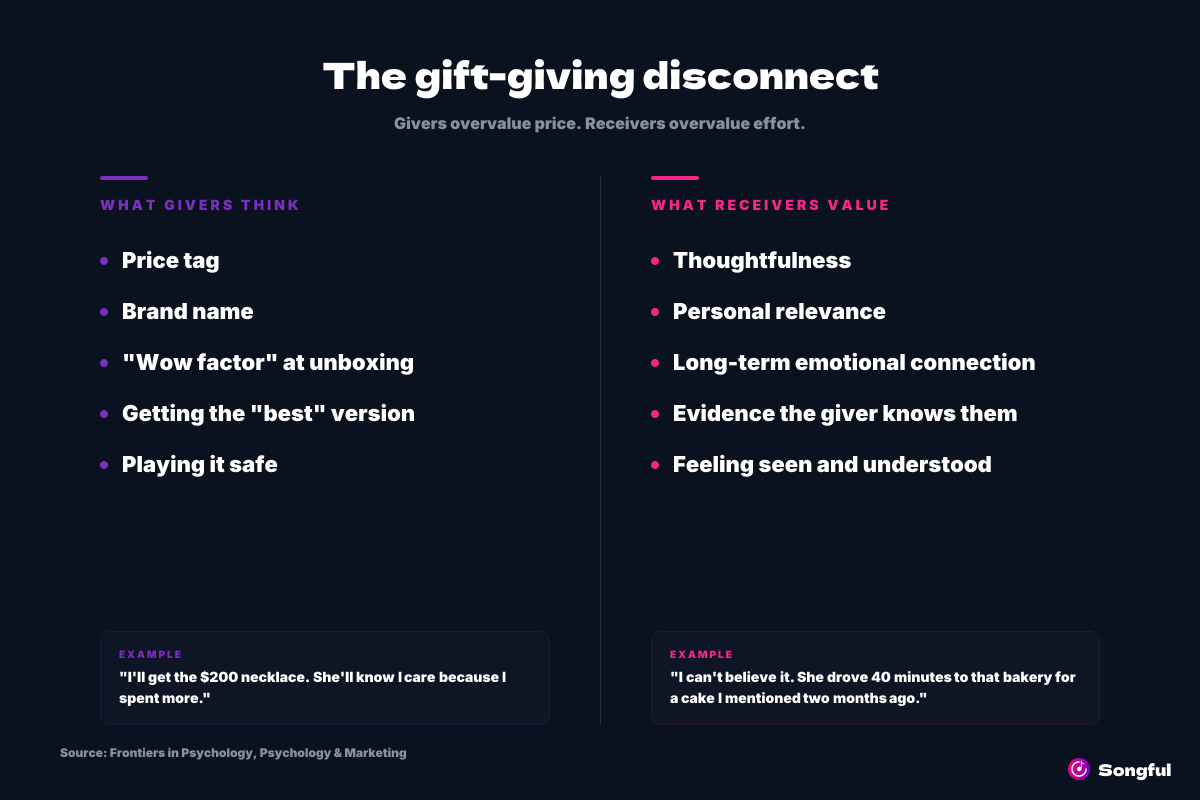
Here's a finding that might change how you shop for your next gift: researchers discovered that gift givers consistently overvalue price, while receivers consistently overvalue effort. In one study, givers rated expensive gifts significantly higher than cheap ones. Receivers? They actually preferred the less expensive option.
That disconnect explains a lot. It explains the $200 necklace that sits in a drawer. The designer wallet that gets a polite "thank you" and nothing more. And it explains why a $15 mug with an inside joke printed on it gets used every single morning for years.
The science is clear: personalized, meaningful gifts create stronger emotional connections than expensive ones. Not because price doesn't matter at all, but because what recipients actually feel when they open a gift has almost nothing to do with what it cost.
The Price Tag Problem: What Givers Get Wrong
Most of us default to spending more when we want a gift to feel "special." It's an understandable instinct. A higher price tag feels like a safer bet, like proof that we care.
But a study published in Frontiers in Psychology found something surprising. Researchers gave identical products to two groups, but told one group the gift cost $17 and the other that it cost $6. Givers overwhelmingly preferred the expensive version. They scored it nearly 60% higher on a satisfaction scale.
Receivers told the opposite story. They actually rated the cheaper gift higher, and the gap wasn't subtle. The researchers confirmed the difference wasn't a fluke: it held up across multiple rounds of testing.
Why? Givers assume price signals quality. Receivers think about something entirely different: how much thought went into the choice. A high price tag can actually backfire, making the gift feel transactional rather than personal.
| What Givers Think Matters | What Receivers Actually Value |
|---|---|
| Price tag | Thoughtfulness |
| Brand name | Personal relevance |
| "Wow factor" at unboxing | Long-term emotional connection |
| Getting the "best" version | Evidence the giver knows them |
| Playing it safe | Feeling seen and understood |
The Science of "Vicarious Pride"
Researchers Diletta Acuti (University of Bath), Isabella Soscia (SKEMA Business School), and Marta Pizzetti (EM Lyon Business School) published a study in Psychology & Marketing that identified a specific emotional response unique to personalized gifts. They called it "vicarious pride."
When someone receives a personalized gift, they don't just feel grateful. They feel proud on behalf of the giver. They think: "This person put real thought into this. They paid attention to who I am." That reflected pride creates a deeper emotional bond than any amount of money can buy.
The study also found that recipients of personalized gifts were more likely to care for them longer, repair them when damaged, and keep them for years. A generic luxury item might get replaced when a newer model comes out. But sentimental gifts with your name, your story, or your inside joke on them? Those become irreplaceable.
Why Effort Beats Price
Research on behavioral costs in gift-giving confirmed what the other studies hinted at: perceived effort has a stronger influence on gift satisfaction than monetary value. The researchers found that receivers are more sensitive to behavioral cost (the time, mental energy, and creative effort a giver invests) than to monetary cost.
"The Effort Signal" works like this: when you receive a gift that clearly required thought, you read between the lines. Someone had to know you well enough to choose it. They had to spend time thinking about what would resonate. They had to care enough to go beyond the easy option.
That signal of care triggers a deeper emotional response than even expensive generic alternatives. The most thoughtful gifts don't cost more; they just require paying closer attention. It's why a handwritten letter tucked inside a book they mentioned once six months ago will outperform a $500 gift card every time.
Think about the best gift you've ever received. Chances are, it wasn't the most expensive one. It was the one where you thought: "I can't believe they remembered that."
The Personalization Spectrum
Not all personalization is equal. There's a range, from slightly thoughtful to deeply personal. Here's how to think about where your gift falls:
| Level | What It Looks Like | Example | Emotional Impact |
|---|---|---|---|
| Off the shelf | Grabbed without thought, requires only a credit card | Gift card to a random store | Low: feels like an obligation |
| Handpicked | Chosen with the person in mind, requires knowing what they like | A book in their favorite genre | Moderate: they feel known |
| Curated | Assembled from shared experiences, requires shared memories | A playlist of songs from your road trip together | High: triggers shared memories |
| One of a kind | Made specifically for them, requires knowing their story | A song written about your story together, a hand-painted portrait | Highest: irreplaceable keepsake |
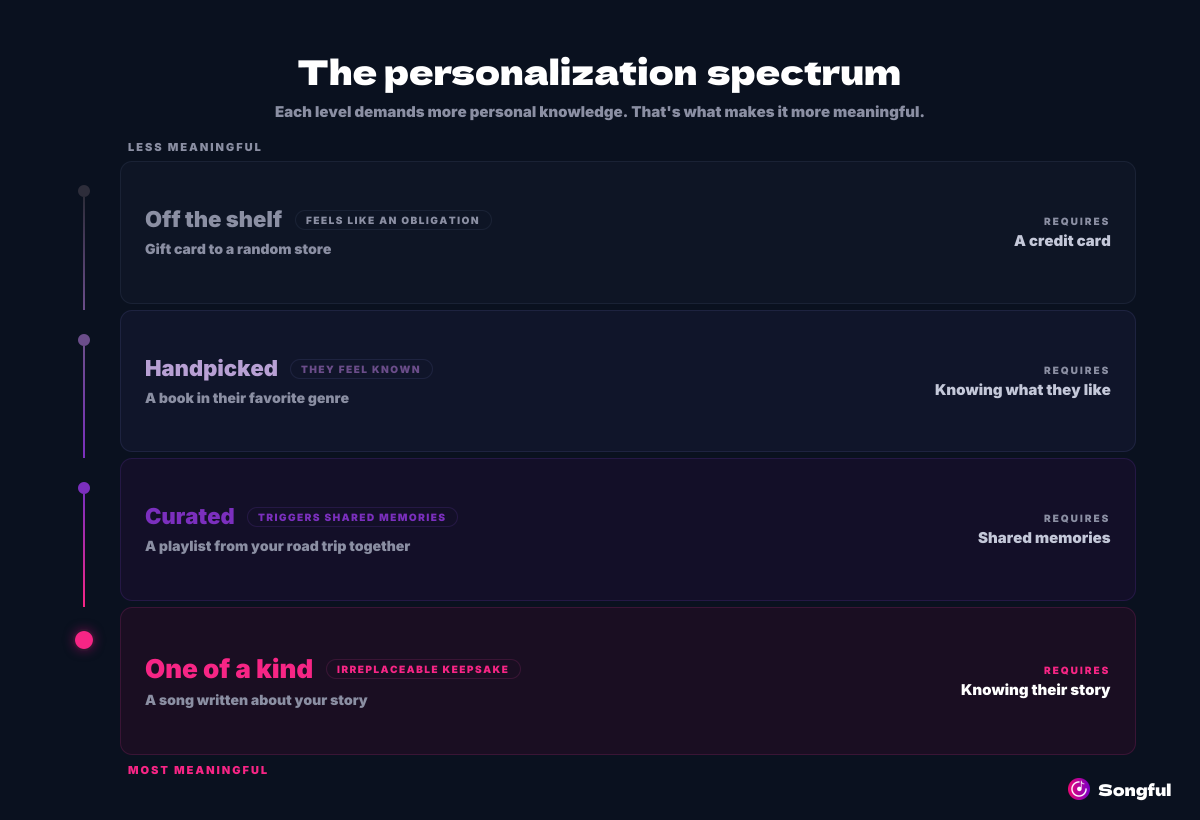
The jump from "handpicked" to "curated" is where most people stop. But the jump from "curated" to "one of a kind" is where gifts become stories people tell for years.
A custom song, for example, lives at that "one of a kind" level. It captures specific names, memories, and emotions in a format that can be replayed over and over. Songful exists for exactly this reason: turning your personal story into a one-of-a-kind song that nobody else in the world has. It's not about the format. It's about the fact that someone cared enough to create something that could only exist for one person.
How to Make Any Gift Personal
You don't need to be an artist or a songwriter to move up the personalization spectrum. Here are concrete ways to add meaning to any gift:
Anchor it to a shared memory. Instead of buying "nice candles," buy one in the exact scent of the hotel lobby from your anniversary trip. The candle costs the same. The meaning is completely different.
Include a handwritten note that explains why. "I got you this because..." is one of the most powerful sentences in gift-giving. It transforms any object into a story.
Reference something only you two would know. An inside joke on a coffee mug. A photo from a moment nobody else was there for. A line from a conversation you had at 2 AM. These details prove you were paying attention.
Create, don't just buy. A homemade meal beats a restaurant gift card. A curated photo album beats a picture frame. A custom song about your relationship beats a Spotify playlist. The common thread: you built it, and that building required knowing the other person deeply.
Give your time alongside the thing. Pair a physical gift with an experience. Concert tickets with a handwritten note about the first time you heard that band together. A cookbook with a date night planned to cook the first recipe together. The object becomes a trigger for the experience.

What This Means for How We Celebrate
The cultural shift away from expensive gifts isn't just a trend. It's backed by decades of consumer psychology research. People are increasingly choosing experiences over things, stories over status symbols, and meaning over price tags. Whether you're planning a birthday for someone you love, an anniversary, or just want to show someone you care on a random Tuesday, the principle holds.
This doesn't mean you should never spend money on a gift. It means the money matters less than the thought. A $30 gift chosen with deep personal knowledge will consistently outperform a $300 gift chosen in a panic.
The best gift you can give someone is the feeling of being truly known. Everything else is packaging.
Frequently Asked Questions
Do personalized gifts really matter more than expensive ones?
Yes, and the research is consistent on this. A study published in Frontiers in Psychology found that gift receivers actually rated less expensive gifts higher than expensive ones, while givers assumed the opposite. Separate research in Psychology & Marketing showed that personalized gifts trigger a unique emotional response called "vicarious pride," where recipients feel a deeper connection to the giver. The pattern across multiple studies is clear: thoughtfulness and personal relevance consistently outweigh price in determining how meaningful a gift feels.
What makes a gift feel truly personal?
A gift feels personal when it signals that the giver invested thought, not just money. The most impactful personalized gifts reference shared memories, inside jokes, or specific details about the recipient's life that only someone close to them would know. Research in the Journal of Consumer Psychology found that recipients are more sensitive to behavioral cost (the time and mental effort behind a choice) than monetary cost. So a $20 gift that required knowing someone deeply will feel more personal than a $200 gift that required only a credit card.
Are handmade gifts better than store-bought ones?
Not automatically. What matters isn't whether a gift was handmade, but whether it demonstrates genuine knowledge of the recipient. A poorly made craft that doesn't connect to anything personal won't outperform a thoughtfully chosen store-bought item. The key variable is personalization and effort, not the production method. A store-bought book inscribed with a note explaining exactly why you chose it can feel just as personal as something handmade.
How do I personalize a gift if I'm not creative?
Personalization doesn't require artistic skill. Start with what you know about the person: a memory you share, something they mentioned wanting months ago, a joke only you two understand. Then attach that knowledge to a gift. Write a note explaining your choice. Reference a specific moment. You could also use services that do the creative part for you, like custom songs, engraved items, or photo books. The creativity is in the knowing, not the making.